Friday, 14 February 2014

negativity bias : no such thing

Negativity Bias is a term that sometimes crops up in creative circles. Negativity bias is sometimes cited as the reason clever people stomp on new thinking. It’s a term that we think needs to be treated with caution as it’s all too easy to over simplify things and allow good science to become poor science and then turn into even worse advice. The heart of the argument is thus: our capacity to weigh negative stimulus more heavily than positive most likely evolved for good reasons —to keep us out of harm's way. From the dawn of human history, our very survival depended on our skill at avoiding dangers. The brain developed systems that would make it unavoidable for us not to notice danger and thus, hopefully, respond to it. Those caveman that stepped outside the cave when they saw a sabre tooth tiger rarely came back. We thus treat new thinking in the same way; with huge caution and we quickly crush exploratory ideas as threats;  it’s un avoidable.
Genius says ‘rubbish!’
In today’s world we think this is bunk. It’s an excuse NOT to do things and ignores that we live in the 21st century. Excuses for our poor behaviour can’t be attributed to dodging danger as caveman.
Consider the rebuttals from our clients…
1.        Our minds are not fixed as cavemen. Seriously? Is this a solid argument? The human species evolved over millions of years and latterly in the tens of thousands we’ve accelerated our development amongst socio and contextual settings of our own design. With the shift of our ancestors from roaming hunters in isolation, that feared prey, we grew to agricultural masters of our environment, grew into large communities, extracted energy from the land and fended off sabre tooth nasties in groups using rocks, sticks and a bit of yelling. We now find ourselves at the top of the energy and food chain. We evolved languages in parallel to the discovery, trade, storage and harvesting of grains and developed metaphysical cognition that manifested in religions, rituals and worships as a result of such farming practises.
The human species has not got a caveman brain.
We do not get hijacked by fear when new ideas are presented in brainstorms and meetings at work.
We do not fear new thinking.
If it were the case, then nothing around us that we’ve created would exist now would it. Despite all the intellectual rock throwing, the mavericks still get through. And despite all the shitty process and procedure in business that we consultant agency types hate, work still carries on. Coke sells itself, interest rates fluctuate, mums buy soap powder & egg free cake mix and marketing managers make PowerPoints.  Same today. Same tomorrow.
2.       Proposing that we humans have a negative bias as default can’t be the case when citing the opportunities children see over adults. There is no shortage of opportunity in a primary school classroom and no sense of wonder when we’re 5. Negativity bias is simply the register of intensity that negative things have over positive. We remember the shitty stuff more so than the good. But we can also remember the good. Our perception of time and positive emotion is warped. Look up the studies for yourself. It’s important to invest in the positive to counter act the visceral experiences of the negative, but it’s all fluctuated and all behaviour, after all is learned. We don’t crush ideas and new thinking in business because we’re negative, we crush ideas in business because we have learned to do so by copying others. Mostly our boss, his boss and the person we’d most like to be liked by in the room. “I agree with what Simon says”…( a phrase commonly heard at Canary Wharf).

3.       Finally we don’t like negativity bias as a concept as in the world of instructional design, LTROD and innovation, it’s a “gotcha”. For example “hey there’s no such things as negativity bias, that’s’ bunk”, “see, you‘re being negative, so we’re right and thus proved our point”. And so on. You can’t defend an argument by using the argument in and of itself as your proof point. Brilliantly put into humour by Douglas Adams when a talking fish explains to God that as he, the talking fish exists, is evidence and proof that a divine creator exists; and of course with proof, there is no need for faith and without faith God can’t exist and so God disappears into a cloud of logic…
Smart. If a little too clever.
The point is it’s ‘bad’ to explain to clients who stamp on ideas that they are negative and their actions will perpetuate their behaviour inevitably to the vice.

So this leads where?

Yes, subconscious forces come into play. Edward Bernays famously took the powdered egg out of cake mix in the 50’s to stop mums feeling guilty about baking without making an effort (it still stands to this day)  and lipsticks sell in tandem with the cycles of the moon. But we’re not negative to new thinking because we once got eaten by tigers as cavemen.


We stomp on ideas because were smart, clever people with high standards that are unique and special to ourselves. People that don’t match the same pattern as us are immediately attributed with labels by association. It’s how our mind works. It does so automatically, subconsciously and at speed. It takes seconds for us to work out whether new thinking is useful or not useful to us. Does it fit our path for the day? will it help my meeting? Will this half-baked idea actually solve my issue or get in the way of my next promotion? Do I want to be associated with chaos or a clear plan my boss wants…


We live in a built environment that pampers our immediate and long term needs and we’ve a growing distance between that around us and an appreciation of the efforts, magic, skill and energy it took to create such. We need to remind ourselves that new thinking created it.


Those reading this far done the article may have already found fault with what’s written. You may have thought “not so, sonny” (or different words but same sentiment). You’ve done so not because you’re bias to the negative, you’ve done so as our map, doesn’t fit your map of the same territory. It’s not a bad thing. In fact, we’d rather we have some adversarial discussions and it all helps challenge one perspective against another. It’s important however to let go the ‘right’ over ‘wrong’ argument as all that creative energy is put on proving one point of view over another.


The how will argue for itself.


Those that succeed in pushing through innovative thinking and creative process in business need not worry about our innate ability to create the ‘new’. We can do that. What leaders and sponsors of new programmes can do is grow better awareness of is the systems, structures and processes that recognise, isolate and correct the behaviours that  make for better idea generation and better creative culture.

Making our excuses and blaming our ancestors won’t get you far.

Taking initiative and embracing opportunity with get us much further.


A copy of this blog is found on our website www.thegeniusbox.com

Wednesday, 12 February 2014

We have moved!

thanks for following the blog, dear reader.

Catch us on www.thegeniusbox.com from now on.  We've even split things up into categories of LEARNING, DOING and THE RIGHT ENVIRONMENT.

expect updates soon.


Wednesday, 15 January 2014

Quick 6 point test to make your Innovation Conference rock.


Firstly.

Send absolutely no pre-work to any of the delegates (all of whom should be chosen at random). This way everyone arrives with little or no idea about the overall purpose of the event and thus their attention and focus can wander at will.  Remember innovation and creativity is all about experimenting. A free mind will be the best learner.


Secondly.

Have a stack of lengthy biographies on each of the speakers to hand out on the day. Specific emphasis made to their early career is important. Obscure qualifications and affiliations to places you’ve never heard of, is essential. Make sure to include a low-res image of your speaker in a suit; looking sincere and chewing on a pen or arms folded in a reassuringly professional manner.  Speakers with no connection to the topic and preferably those who have to fly long distance to talk about CSR are particularly good value.


Thirdly.

Make no use whatsoever of social media, live interactions, current news, video, film, illustration or music. The best conferences are ones where the audience sits in darkness whilst watching an 8 hour PowerPoint presentation using the conference template.  Numerous bullet points and illegible charts are a pre-requisite, as is a black and white A4 print out to stack in the foyer by the coffee machine. Running over time progressively as the day moves on is acceptable. In the world of innovation, it’s important to break the rules, so squeezing or cancelling the final session is living that value authentically.


Fourth.

Cram as much borrowed interest and distraction as you can on the outside of the auditorium. Jugglers, flame throwers, motorbikes and popcorn are well liked. Those dudes who bang on biscuits tins and oil drums are a particular hit too. Nothing puts your conference content into business context more than a branded pen, mouse mat and bag with your logo, so spend as much as you can here. The bigger the gift bag the better.


Five.

Spend 45 minutes at most on open discussions, brainstorms, breakouts groups and Masterclass sessions. This is best done between 3.30 and 4.15 in the afternoon. There is no need for anyone to facilitate these discussions, land output in a useful form or capture in a meaningful way that’s shareable. A conference is about boundary breaking and after all, Rome wasn’t built in a day so best to manage expectations.


Finally, six.

Get everyone to sign their name on a wall of commitment on exit. Nothing says “I want to make our world a better place” more. This can be the last thing that’s pulled down at the end of the day and dumped in the skip as it’s important people see their commitments through to the end. Following up is important, so emailing a set of photos of the audience looking glum-as-fuck throughout the day really hammers home the impact your innovation conference has had.


Enjoy your planning.

Wednesday, 18 December 2013


Keep the main thing, the main thing.


I was sent this image earlier in the week by a member of the extended Genius family… it’s self evident what the brief is, what’s expected and even has some political and behavioural guidelines around getting the project done.  Smart it is. Simple. Elegant.

 
Racing forward nearly 70 years later, we don’t see a great of this anymore. We get pitch documents, and proposals and white papers. These sometimes needlessly over complicate. The summary advice feels a bit obvious from time to time. And less we forget the agency and clients involved, they neatly place both logos at the foot of each page. Handy.

Before the world of latte drinking consultants developed, briefs like the above were ambitious and open enough to invite debate and question, but more often than not, shit happened and stuff got done. Perhaps the same sort of wishes are sketched out today in boardroom meetings and then handed to the procurement people to get into finer detail (and maybe there was indeed a more lengthy set of specifications for the floating barges) but the main objective was common to all. Everyone knew what was expected, what wasn’t, what to do and intuitively what to avoid. Call it a strategy if you like and type it up – but you still don’t make things happen. I like the idea of all our projects following the same format.

If it isn’t on a page – it won’t get done.

Next year represents a massive opportunity to spread more growth amongst our client base and spread even more genius thinking around.
My challenge to everyone on the books both within and outside of our business is to start 2014 with the key objective on a page. Let's all keep the main thing, the main thing. Think about that over the festive season.
 
See you in 2014.
 

Saturday, 23 November 2013

get a point of view and stick to it...

Been super busy of late - sorry reader.

Here's the best piece of genius I've seen in ages. I hope this guy is still working and hasn't quit as I think the language is brilliant:

http://www.alittlebitofsomething.co.uk/

I get it.
I love it.

some people get it.
and won't love it.


and that's just brilliant as it saves everyone a lot of time needlessly sitting on the fence...

genius.
 

Friday, 11 October 2013

car design : no innovation.

Here's and aesthetic ponder for you.
 
 
What colour is your car and why did you choose that colour?
 
 
Black?, silver?, gun metal grey?, a washed out metallic green? In shot BORING COLOURS. Why.
Go to a B+Q or a Wickes and you can get 2000 colours+ for the inside of your home. In fact with a colour match technology it’s possible to mix almost any shade form the three primary colours right?
Why then are car designers short on palettes. Are they exhausted from the years of development in getting the lines of the outside ‘just so’. Most cars are now (dare I say it) the same.  They’ve all got the same spec. and performance and equally as forgettable in shape as the next – unless you experiment.
But that’s the challenge – how can you experiment and express your personal style and brand when the choice is poor in style and colour? Surely the insight people at 'cars inc.' are aware that almost every other part of our material lives is open to personalisation... phones, fabrics, clothing, holiday choice, home décor, food, lifestyle, reading choices. it's all up for grabs.
 
Unless you want to buy a car.
 
any colour and shape you want as long as it's a shade of crappy grey or black and looks like a BMW.
 
I also heard how it might cut car crime. Consider this…
“and the getaway car madam?”
“looked like a saloon. Black I think, but it was dark…”
 
 
vs.
“and the getaway car madam?”
“oh, long, 6 wheels, mint green with dots…”


Friday, 27 September 2013

Our want for immediacy kills getting things done.


Long one this week - and rightly so. If you're in a rush. Stop and read.

 
I listened to the radio whilst driving into London last night. The topic was on broadband connection and speed of downloads.  People ringing up and complaining that they couldn’t download podcasts, songs or films without ‘unacceptable periods of waiting’. On hearing how long these people had to wait, I hear that in some circumstances they’d endured (wait for it) 20mins.


20mins.


The world is in a rush to get things done fast, but I’m unclear as to WHY? There seems no benefit to accelerate waiting activity and reduce bottlenecks as observing behaviour after the fact simply doesn’t add up.

Let’s look at some examples.

I fly a great deal. I spend a great deal of time on planes.  Some long haul flights are 13 hours.  13 hours cut out of a day makes any productivity a right off. So either side of a 13hour flight you should concentrate on getting too the airport and enjoying the journey away from the airport. That’s it.

There are a proportion of business class flyers (and you know who you are) whose interpretation of hand luggage is grossly distorted. These people who are usually three gins to the wind upon boarding are the first to ‘tut’ when the pilot announces after a 13 hour flight that we’ll be an additional 20mins in the air to allow for air traffic clearance of something; like the world owes them a favour! Once down, no sooner have the tyres stopped moving – and in some cases still moving – these people are up out of the seats, grabbing their overpriced TUMI’s and marching up the aisle. They adopt a semi jog/walky stride (akin to a child with a loose bowel) up the HSBC ramp off to arrivals.  Of course without luggage to collect they can then breeze through passport and off to their destination ahead of everyone else.  WHY?

After 13hours you can’t have been that stupid to have booked a meeting. You are either going home, where you’ll potter about the kitchen and walk about the house, have a shower and aloow time to drag on or you’re off to a hotel room to do the same mundane personal human tasks like unpack a toiletries bag and order a club sandwich. There is nothing urgent you have to do and if you did organise something shame on your intelligence to do so with moments after a landing – did your professional life and diary planning and this flight come as a shock?

You’re dicks.

On the subject of high speed downloads. Think about it.  If your downloading a film that’s 2 hours, then why the fuss that it takes 20mins to come down your fibre optic.  Surely you’ve set aside a ‘free’ evening where you can open a bottle of wine, plump some sofa cushions, turn down the lights, light a candle and enjoy Fast’n’Furious6? Why not… er.. download the film overnight or during the day – I’m a little , no I’m a LOT shocked that the basic ingenuity of a human being can’t do this simple trade off.

Remember the computer games of the 1980’s when they arrived on cassette. We used to tip toe around the player as vibrations would make the tape heads wobble and the whole loading process would have to be started again.  After loading game over a period of 15mins we’d play ALL DAY. Why the review that things take so long to load when the rest of the day was spent playing the game – doesn’t make sense.

Some of us will remember ordering tapes, records, books, games, furniture, photos and so on using order forms and postage. 4-6 weeks we’d wait for precious holiday snaps to come back from ‘Trueprint’ or go to Our Price and ‘order’ a Bangles CD to arrive in the next delivery (often a week or two later).

My final example is more personal. I used to play piano. I’m now VERY rusty. ‘Back in the day’, I’d order sheet music which cost a small fortune and had a lead time of about 8 weeks and then I’d collect from the music store across town. I’d go home and I’d practise and practise.

I’ve now You Tube. Someone has generously filmed their fingers play in slow motion and printed out the score for me and for a few dollars I can download and print instantly the piece I want to play. Wish is exactly what I don’t do. In fact, I’ve reams of unplayed music scores sitting under a bed gathering dust. The piano has become a quasi coat shelf in the spare bedroom and I still won’t play.

My childhood in the 1980’s consisted of a great deal of waiting and looking back it probably did me a lot of good. The experience of NOT getting what I wanted immediately must have taught me something. If it didn’t then at least I know what it’s like to feel that way and adopt a way of living with such emotions.

Let’s now look at business as it’s here things get really interesting.  If at a personal level, we want things NOW and we travel business class with over sized hand luggage to leave the airport earlier than everyone else, to race home and download a film in seconds so we won’t watch it until another day… then it stands to reason all that passion and power would amplify in the corporate environment right? It would add up that all those impatient people who bang doors to get on overcrowded trains, who run up escalator stairs, who want a skinny late on the go and speed across town in white Range Rovers NEED to get shit done at work. It would be the case that in agency briefings we’d get told were working toward objective lead and time oriented briefs and projects and the senior managers really see this as a priority… right?

It’s not so is it.

Thomas Homer Dixon talks of an ingenuity gap between the natural capacity as humans to deal with the ever increasing world in which we live and design.  I think he’s right. I think also there is a patience vs. immediacy divide in the leaders, managers, business class flyers and film downloading population in the world.

My solution is to focus business in NOT doing anything.

Let’s face it, if we achieve this little by racing around then perhaps doing the opposite and learning some patience would probably accelerate thins for us all.

I’d also like to see patience and waiting getting more praise. I appreciate we have a surplus of cognition as we can get stuff done immediately. Some of use our time making YouTube videos and uploading Wiki pages – but for the rest of us, I’d like to see you learn how to manage the impact you have on others when you don’t get what you want in the time you want it.

To ring up a radio station and say 20mins is too long to download a film is unacceptable tells me a great deal about the value you have on the material things.

That’s worrying for us all. Shame on such society.


Go think it over. All of you.


p.s. I don’t hate all business class flyers – just those with over sized hand luggage in a rush. Dicks.


Wednesday, 4 September 2013

CAN WE STOP GOING ON ABOUT APPLE AND STEVE JOBS - AGAIN!

CAN WE STOP GOING ON ABOUT APPLE AND STEVE JOBS - AGAIN

It’s been cited SOOOOOOOOOOOOOOOOOOOOOOOO many times anything Jobby is academic.

I switch off if anyone mentions him or the business.  I believe you can learn absolutely nothing from the Apple story business whatsoever.  I have lost count of the number of clients who have said to me “what we need round here is our version of the i-pod” or “I want to be the Apple of [business discipline]”

 
Utter crap.

There is no greater accelerant to the growing ingenuity gap existing between today’s collective capability and the complexity of the modern world than every object Apples produces. 
 
If it were true that children once grew their imagination by playing with the box their toys came with, then now they sit at the side of the skate-park and play angry birds and not understand anything else. [Academic point perhaps]
 
I've yet to meet anyone with an 'app' that's genuinely useful.  Favourite one so far is 'can't make up my mind what dress to wear so I'll tell my other equally vacant friends and they can help me' app. 

But I stand firm on this. 

 
Business leaders who mention such stories for me lack imagination, ambition and difference.  It’s lazy thinking. I also this its poor consultancy to cite Apple and all the other usual suspects in any document, advice, proposal or paper you're sending to them.  Anyone can do that.  In fact, I knew (know) a lovely lady when on being asked a stupid question from a client replies "let me Google that for you" as a reply to make a point on this.  nice one.

If you're in the consulting business. If you're in the instructional design business.  If you position yourself as an innovator, a creative or an entrepreneur (posh way of saying self-employed), then earn your wage.  Think hard. Ask questions no-one else is asking. Say the opposite. do the opposite - concentrate on DOING the things you advise your clients to DO and stop trying to be all clever and wise with some over quoted story about Apple.

they make phones and stuff you need to plug in and charge up.


It's the 21st Century.
We're supposed to have hover boards, flying cars, white teeth and live to 100.


go turn on the news channels.
fix THAT.


or are you to busy taking a picture of your dog and telling people you've found a new restaurant using a QR code.

Monday, 2 September 2013

Accidental Genius - the best kind

how much would you pay for a plastic desk fan?

£5, £10, £15? tops right.

It's plastic.
it's going to be shitty and hardly last a lifetime.

Take note of this genius at my local Post Office.


We'd all like the idea of a steel art deco esq desk fan, no.  It building nostalgic-film-noir-Agatha Christie-esq images in our minds; oh how our commercial and personal affairs would be lifted by owning such a steel masterpiece...  but not at £42!

now £32 for the ghastly plastic land-fill fan doesn't seem a bad offer does it? a reluctant purchase perhaps but utter genius profitability for the Post Office owner. 

nice one.


Have a good Monday - I opened the window. Free breeze.


Friday, 23 August 2013

If you’re asking for feedback in the wrong way – you’ve nothing good to say about yourself.


On a recent commute to London I fancied a cuppa and a snack whilst awaiting the train. It’s transaction that must happen thousands of times a day across platform kiosks of the UK. I was told the following “if I give feedback about the service I could win an IPAD” (see below).


This was on my mind nearly all day.  Brilliant customer service should be that good it doesn’t need attention drawn to it. But this request and card combination is like a needy comedian. Don’t tell me you’re funny, make me laugh. It reminded me of the time I opened an account with HSBC and at the end of the hour or so to do so in branch, the young banker teller mentioned a feedback form would be on its way and he’d be grateful if I’d complete it as it helped the branch and him etc.  Had he NOT mentioned it – I’d be more likely to do so.

I’m sure there is some clever psychological principle behind all this associated with influence and behaviour and I’d appreciate anyone letting me know what it is. For me right now the advice is this: Don’t draw attention to something you want from people as a request to action. Your ‘attention grabbing/request’ becomes the behaviour of note and not the focus of the very thing you want apprising. For the station café, concentrate on making brilliant coffee, developing banter with the commuters and getting some energy into your café.  This will get more feedback and love for you than your IPAD raffle (which essentially it is). Similarly for you dear reader, if there is something you want from someone, have an attitude and behaviour about DOING not BEING. Too much of our time and effort is about our ambitions and wishes. Stick to what you know, do it well and fall in love with it.  THAT is what people will love you for.  If you’re asking for feedback in the wrong way – you’ve nothing good to say about yourself.


Friday, 28 June 2013

cutting costs can only get you so far.


We’ve spent a good time with clients over the last few weeks hearing they are STILL cutting costs, laying off people, restructuring, recalibrating, re-organising and in some cases probably re-spelling their business.


One way of remaining profitable or paying what staff you have left is to cut cost. I understand that, really I do. After a while though there is nothing else you can cut. You’re essentially turning off the gas that powers your machine.


Who in the business is taking risk, saying ‘yes’, spending money, trying things out, experimenting, investing effort and energy? It’s here the ‘new’ will be found and get you out of the mess you’re in. It’s easy to sit here and type that sentence but there is truth in the adage of ‘what got you here won’t get you there’; Many a grandmother has made omelettes by breaking some eggs.


All this cost cutting is easy for salaried people to commit to. On a good day it looks desultory and on a bad day, just pathetic.


Cut away. Save what you want.


And remain a big business with the same problems you had before – only this time you’ll have no-one left to fix them and a culture who’ve learnt how to say ‘no’.

Monday, 24 June 2013

Keep Clam and... PISS OFF.


I thought it was a passing summer fashion from a few years back, but no the ‘keep calm and carry on” thing is STILL going.

If this has been written about already and I'm last to mention anything then I've been avoiding it until I was sure I wasn't just feeling isolated and missing out on the 'fun'.
 
the cards were one thing... but I’ve noticed a new generation of messages turning into kitchen or hall hanging signage. These appear to have clichés such as “a cheerful house is a happy home”, or “a smile costs nothing” along with other references to dancing, wine, coffee and conversation.  Lots of middle class crap.

I’m saddened and embarrassed for us as:

You’re paying upwards of £20.00+ for something sprayed onto wood and brass chains. This is just shitty landfill assembled by children in china to hang on your fridge.

You could type out or at worst write out by hand on paper the sentiment.

But the worst and more saddening aspect is the belief that this shitty coloured trite makes us feel any better. Like we need to spend MORE on thinking and feeling what a good loving home takes for granted. Why we need to remind ourselves of it is one thing, but to have our family values and home north stars based on varieties of wine, dance moves and coffee conversation is just wrong. Any good intentioned sentiment is lost in the material acquisition of buying the bloody statement in the first place. Shame on you for doing so in John Lewis too.

I’ll choose my own emotions thank you  and I don’t need a poncy lavender board to tell me to do so.


Keep calm.

Piss off.


Friday, 7 June 2013

I thought Karen Brady would be a little more innovative...


t.v. this week provided much joy.


http://www.youtube.com/watch?v=se8JdqjyUrc


The Apprentice season 9 (season 9!!!) episode 6 required the teams to design corporate events.


Much as I'm tempted to get into the content of this, I won't.  My focus is on a Karen comment. I like Karen.  Never met her. Probably won't but for the record, this is all a good intention blog.

 
Anyway.

 
46mins into the programme the candidates are all facing the usual bollocking.

One pipes up and makes a comment about corporate people talking crap.


It’s at this point Karen says “you might find that a rough attitude when you stand up in front of a bank and ask them to invest in your business” (steely eyed look, yet retaining glamour)


Well Karen.


I disagree.


The last place anyone want to ask for investment is a bank. It’s a bit 19th century to go cap in hand to some uptight economist reading home county living banker and ask for a business loan to start an online cupcake business. the last thing we should give up is our opinions and attitude too.


The alternatives are MASSIVE.

Online lending and peer to peer support is growing by the second.

I have two pieces of stimulus to help
1. the excellent what’s mine is yours by Rachel Bosman and Roo Rogers describe in detail how the growing tide of co-created, co-shared and co-owned work and life is very much part of a successful and sustainable future. To be supplicant to a restrictive set of banking terms isn’t worthy or attractive to anyone with a modicum of ambition.  There are also countless currencies out in the virtual and semi virtual world that represent value and credit in context.  Imagine if we got a £1.00 for every ‘Like’...

2. In addition, I met with Microsoft’s CMO this week.  I heard Phillipa Snare talk very openly about her healthy distain for the establishment and authority.  So hooray for the opinions.


Much more attractive than fence sitting professionals.


Apart from you Karen – you’re an exception.  J


Monday, 20 May 2013

co-creation (or should I say the differents engine)...


Been busy this week in Brazil with some of the sharpest minds on the planet.  http://www.differents.com.br/ are challenging the agency model. in fact, I think they're challenging nearly EVERY model.

I think it all needs a push too.

Why buy in ‘experts’ (nasty term) and additional heads of a few agency people when you can work with thousands of volunteers and like minded entrepreneurs on your challenge?

This isn’t about running a suggestion box in the foyer (please don’t do that either) or an online competition to arrive at the answer.
it's not about getting latte drinking agencies in (like me) who make ppts with the same examples (we know the usual suspects and I've written before about this).

This is co-creation.

I feel embarrassed I have only recently started to think about it.  Running an agency out of London it’s easy to get swept away and distracted by hundreds of other agencies and individuals all trying to do the same thing.  We use the same language in describing what we do. Usually this is about ‘being fresh and different with a little strategic thrown in’. I can’t think of a client who’d NOT want an agency who didn’t value working with customers and insights to arrive at new ideas – what’s the alternative... I leave the reader to ponder.

Co-creation gets me excited as if the facts are anything to go by then we can all say cheerio to the business models that got us here.  Good bye banks – peer to peer lending rising year on year. And perhaps goodbye brands too.  Co-creation is here and it’s time to ship up or ship out! I love the idea that consumers get a say in what they want the brands that they are fans of do and say. innovation is dying.  I'm surfing the co-creation wave.

Go to it and thanks Differents for the week.

I’m off to buy a 3D printer and find me some more brain power.

Friday, 3 May 2013

bitesize shot or weekend away...


Been racing around the world with the team recently hence lack of updates but here’s something to keep you going for now.

 
The health spa vs. massage debate.

Is it better to put your learners away for a week or expose them to a series of small bitesize chunks over a number of weeks or months...  mmmm.

Opening the batting in a consistently brilliant fashion is the guru of learning Dr Seb Bailey from the Mind Gym. Here’s a starter for 10:


my thoughts are. You learn not what the lecture told you but what it caused you to do.

If it’s content (regardless being 90mins or 9 days) failed to engage you (for whatever reason) then you’ll learn that you can attend workshops and check your email without being spotted, think negatively and daydream about running up to the MTV beach house...

Nail the causing piece and you’ve got it cracked.

In a shameless piece of trumpet blowing, we worked with the CEO and team of JWT MENA last week on unlocking business issues that had rattled around for a while. It took 3 days. These guys worked day and night. They rocked. Like Aerosmith BUT they also realised very strongly it is their immediate action after the workshop that seals the learning.

For me nothing happens during a learning intervention when the learner is conscious of his/her experience in the classroom. It’s when you pass it on AFTER the event you realise what has been acquired.

At the point of transfer you aint you; it’s like suspended animation. And like a CD on pause, 90mins or 3 days can pass instantly when you’re in that status.

Now,

Go think.

Sunday, 7 April 2013

CUSTOMERS AT THE HEART OF EVERYTH...zzzzzzzz

Put 'customers at the heart of everything we do' in a search engine and see what you get.  The highest number of related comments I got when search was 99 million.

What made me smile more wasn't the quantity of material, but the range. On one page I saw that both Thompson Reuters and William Hill the book keepers put customers at the heart of what they do.  Along with tanning salons, cake makers and of course, your business.

I believe that 'putting customers first' etc. has become another platitude.

three reasons I think it's a 'fail'.

1.  If you are putting customers first, you don't need to tell them.
2.  Customers is a generic term. No two are the same and although a few may be groups because they all want the same loan (or car, or t.v, or fake tan) they did so for different reasons, their friends will give them different comments and 5 minutes later, you can bet (on William Hill) they'll want something else that differs to each other.
3.  If every business achieved this customer utopia, then there would be no effort in the world needed at the customer end to discriminate and discern one quality of service from the other; think about it. It's because some offerings are poor that the customer chooses you over another - but then if such were the case we could do nothing and wait for everyone to make mistakes right? if only life were THAT easy.

But putting customers etc. almost creates a platform that no-one can own and thus you're setting the conditions around yourself that you can't satisfy.

odd one this.

I've been asked to think about a 'customer centric brief' and as such feel it's worth a longer explore to get to know the brief.

if only we did the same with all our customer requests...


Monday, 4 March 2013

note bag does not inflate.

Thomas Homer Dixon speaks of the ingenuity gap. That growing distance between the complex world in which we live and our natural ability to deal with it.  It’s a compelling argument.

Here’s some evidence to make you smile as it did me; evidence of genius at work.

See attached  shot from my local off licence.


I guess the owner got so tired of repeating herself time and again the request for customers to hang on until the machine WAS ready that she stuck the sticker on instead.  It took less than a minute of her time and has made her life at the till easier.
 
The designers of the chip and pin machine spent £millions in its development yet over look the insight that people do follow machines in a certain way despite being asked to do other actions...

 
I’ve spent several of the last few weeks on planes. Can’t help wonder when someone will come up with a cellotape solution to the international expectation setting clause of ‘bag will not inflate’...  perhaps design another bag or hope someone bridges the gap with some ingenuity.

Thursday, 21 February 2013

Conference Cliches - 6 gems of advice so you rock rather than roll...

We’ve been about on lots of plane trips recently and spoken at a few events and got the year off to a strong start.  The tongue in check nature of what I write here is meant to provoke my dear readers into think long and hard about any content and delivery you have planned for your own conference appearances.

1. It’s massively important to make a link as explicit and as a strong as you can to the headline of the conference and the presentation you give. You audience are being boomed at all day by dozens of PowerPoints and stimulated by nothing but free mints an luke warm coffee. They don’t want to be given an intellectual resume of your business performance, your cleverness (that’s just isolating) and you shouldn’t ask them to work hard to understand your speech.  If the conference is about HR ENERGY, then your speech should be about HR ENERGY!!!

2. Write your content so a BABOON can understand it. If it contains material that hurts a scrabble player, take it out.  The best guide is FEWER. BETTER. WORDS.

3. Have pictures – they paint a thousand words, but don’t get them off ‘getty’ etc. anyone can do that.  Impress me with your own photography of a moment in life that you captured and made you think. If you don’t do that, I’ll just ignore you and play with my mobile along with the guy next to me.

4. you don’t need to out the ENTIRE CHART OF 1000 figures to show me result went up 65%.  Just tell me. I’ll believe you.

5. If you find yourself saying “the point i’m trying to make...” in your speech. It fills the room with doubt.

6. The reaction you get is the communication you give. (yeah, thought i’d leave you with a philosophical one)


And now some fun...

 
Here’s a chart of stand cliches.


In at number 5 is “man suit  holding world in his hands” . Not seen this one since “shrub in soil held delicately in palm of child’s hand” became out of fashion. What I enjoyed about this photo was the poor resolution of the printing.  Close up he looked like he was made of Lego.


In at 4 is “conference bag made from environmentally friendly fabric”.  This allows users to gather up as many pens, leaflets and free mousmats as possible before throwing them away in the trash to become more landfill; genius.


At 3 is conference muffins and sweets.  Nothing sells contract mobile packages, or fleet hire cars more than sponge and sugar and an empty glass bowl where all the sweets used to be


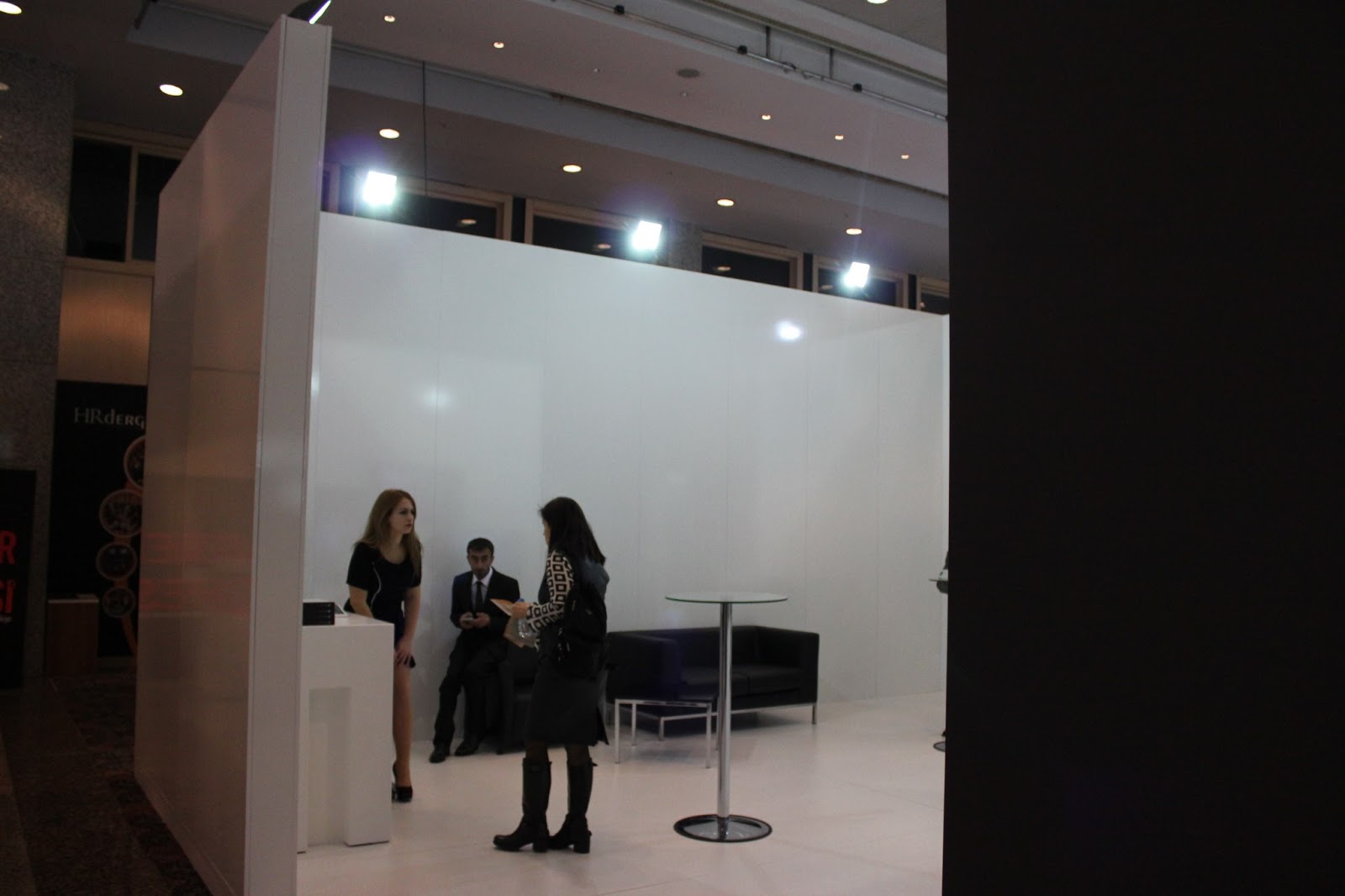
At 2 is a BIG EMPTY WHITE BOX. So ... your brand is about what exactly?


And my favourite from this year is an insight stand where the monitor is ... off all bloody day!!
 Not a single insight to be found despite three juniors searching their facebook page for the answer below.


See you next conference.

Sigh.